Moon

Moon

Tuesday, 2 February 2016

An extraordinary two days with the Sun

Hi all,

I had the opportunity of some time with the Sun over two days.  And a most extraordinary shows the Sun put up on these two occasions!

On the 29th of January, there was a tremendous amount of prominence activity visible, two distinct sunspot areas, and a lot of filaments and plages.  It really was a smorgasbord of features to choose from.

I settled on a quadrant that had a wonderful assortment of prominences and a sunspot region that was very close to this limb.  Littering this limb were spicules, inclined proms, broken arch proms, tree proms (which are pyramid proms that have been displaced laterally), and mound proms.  It was quite a rich display of prominence varieties.

The sunspot that was close by was surrounded by an amazing amount of filaments and plages.  The more I looked, the more detail I could make out.  It was an exercise in throwing around different eyepieces and stopping down the aperture to find the best combination of EP, scope and Quark that brought out the best results.  And with conditions being quite reasonable for mid-summer, it was a fabulous chance to push the Quark filter.

A hero that popped up was a 13mm Hyperion eyepiece that I haven’t used for some time.  I’ve modified it to make it a better optical match with my fast Newtonians by swapping its Smythe field lens with a barlow.  Works very well this way.  But with the swapping of field lens, there is a change in focal length, closer to 17mm, and a wider AFOV over 70°.  I considered using it with my Quark as I remembered that it is possible to remove the field lens altogether and you end up with another eyepiece, in this case a 23mm eyepiece.  I ended up swapping between the two focal lengths of this Hyperion eyepiece.

Object:  Variety of proms, sunspots, filaments and plages
Scope:  ED80 f/7.5
Gear:  modified 13mm Hyperion, Daystar Quark, 148X
Date:  29th January, 2016
Location:  Sydney, Australia


The second chance came on the last day of January.  The forecast was for overcast conditions, but it unexpectedly cleared up.  So, quickly grab the scope and Quark!

WOW!  What an apparition was waiting for me – a HUGE Coronal Mass Ejection (CME) was hovering just apparently detached from the surface!

I have been wanting to view one of these spectacular ejections, but it was always going to be a lottery, pot luck, chance, fluke, culo, or just plain lucky to see one.  And it happened!

Adding to the spectacle was a variety of prominences.

The CME was floating above the surface, being held in place and pushed and pulled by enormous magnetic fields.  Streamers of plasma swirled, plunged and soared right before my eyes.  This feature was changing so quickly.

I ran inside to call the kids out to have a look.  The first remark from each was ‘WOW!’.  I told them to slow down and take their time, and they also saw the streamers of material shooting around.  I got as much a buzz from their excitement as I did from the view from the eyepiece.

What is staggering is when one begins to fathom the distances being covered by this material, it is truly astonishing.

Object:  Coronal Mass Ejection and various prominences
Scope:  ED80 f/7.5
Gear:  32mm Plossl, Daystar Quark, 79X
Date:  31st January, 2016

Location:  Sydney, Australia.


I hope you enjoy these pieces.

Alex.

Friday, 15 January 2016

Inspiration and Experience

Hi all,

Finally, a clear dark site night!  And I got to spend it with my best mate – my son!

We headed up to Katoomba Airfield on Sunday afternoon.  The clear sky over Sydney started to cloud over to thunder clouds the higher up the range we got.  But this was a typical afternoon storm that often happens in summer, rips in, pours, blows and roars, and is all over in 5 min.  And the rest of the evening is crystal clear.

My son had his little 114mm scope that I made a table top dobbie mount for.  With a stable mount, as a first telescope it is a fantastic little instrument for a child.  He quickly got the hang of using both eyes when using the red dot finder, and revelled in bringing up a target and telling me he found it so quickly.


His nine years struggle with the sheer size of the numbers involved with light years, and the concept of hundreds of thousands of years, and millions of years it takes for light to cover such vast distances.  His immediate world revolves around moments and hours through to agonizing days.  But 50 million years, well, most people struggle with that one…

His nine year old eyes also put my eyes to shame.  He counted 8 stars in the Pleiades naked eye!  I can only see 6.  And didn’t he take glee in that!!!

But he is still only nine, and the Sandman finally wore him out.  Then it was my time to play…

Conditions were not crash hot.  Seeing was only so-so, and transparency was challenged with the high humidity due to a long spell of recent wet weather.  What to sketch in these conditions was a task.  The Horsehead nebula was visible, but with the poor transparency it was not as distinct as it can be.  And other objects I considered would take too long and I was feeling fatigued after a long day.

Then a memory came to me of a photo I had seen in an astro shop in Sydney over a year ago of a beautiful galaxy, taken by a customer of the store.  The spectacular ‘Meathook’ galaxy in Volans.  This was the inspiration I required! It is an intriguing barred spiral with its arms tidally disrupted by an encounter with another galaxy a long time ago.  And these disrupted arms can be seen in a telescope of sufficient aperture.  Being located so far south, it has missed being place in the Arp catalogue of unusual galaxies, where it would most certainly be better known and explored.

The Meathook has a curious two consecutive NGC number designation, 2442 & 2443.  This comes from its discoverer, John Herschel, seeing its curious asymmetrical shape and believing it to be two separate nebulae.  We take it for granted today what galaxies are, but before the 1920’s, galaxies were thought to be nebulae.  The concept of galaxies being islands of billions of stars is a relatively recent one.  So the Meathook gives us a unique insight to what the universe was thought to be and the evolution of astronomy as a science.

This Sunday night, with the less than ideal conditions, the Meathook demanded all my observational experience, all my observing tricks, and a plunge into my eyepiece kit to find that one eyepiece that would give me the best visual image.

As all my dobs are push-pull, I was constantly nudging the 17.5” beast at 200X magnification.  This was a good thing, as this had my eyes constantly being refreshed by the moving image, making visible those faintest of details that a static image loses.

Just above 2442, another more distant galaxy can be spied out, PGC 21457.

It was great to be able to land a galaxy that I was introduced to by a photo a year before.  And the image of the photo matched the spectacular appearance in the eyepiece.

Object:  NGC 2442/3
Scope:  17.5” Karee push-pull dob
Gear:  10mm XW, 200X
Location:  Katoomba Airfield, Australia,
Date:  11th January, 2016
Media:  Soft pastel on black paper


The second sketch I managed also had the same set of inspiration and experience ingredients.  When I completed the sketch of the Meathook, the memory of a correspondence with a fellow amateur, Glen Cozens, was triggered.  Glen has a particular interest with the 19th century astronomer James Dunlop, who discovered hundreds of objects in the early 19th century from Parramatta, now a western suburb of Sydney.  Today, his work is commemorated with the listing of his discoveries as the ‘Dunlop Objects’.  I had asked Glen which of the Dunlop objects was his favourites, and I remembered he replied that NGC 1313 was one of them.

Dunlop 28 (its Dunlop designation) is a face-on spiral galaxy that is also known as a ‘starburst galaxy’.  This is because of the enormous amount of H2 regions that has been triggered caused by a recent encounter with another galaxy.  The gravitational tidal forces at play from this encounter has triggered a huge amount of star formation from the hydrogen gas and dust within the galaxy.  The gravitational tugs and pulls caused this gas and dust to become compressed.  This compression means an increase in mass density, and conversely an increase in the gravitational pull of these fronts, so attracting more gas and dust to the front, and eventually causing this gas and dust to coalesce into stellar formation regions, seen as bright pink areas in photographs of 1313.

The Large Magellanic Cloud is another starburst galaxy, whose massive stellar formation activity has been triggered by the gravitational influence of our Milky Way galaxy on this dwarf barred spiral galaxy.

The gravitational interruption it experienced long ago is seen by the irregular arm structure the galaxy has as it slowly recovers from this interruption.  As a result 1313 in my scope has a blotchy appearance.  These bright blotches are huge glowing h2 regions where a massive amount of star formation is happening.  Unlike most other barred spirals, 1313 also has a bright diffuse disk that fills in between its two main arms.  Stable barred spirals show next to no disk between the arms as material has been cleaned up into a more structured shape.  Adding to the allure of 1313 is that a faint spur can be seen coming off one of the arms, which points away from the disk, somewhat like a tag.   Recent ESO wide field photographs of 1313 show a massive amount of material that extends well beyond what we see as the disk.  This material more than triples the angular size of 1313!  The ‘spur’ that I saw in my scope is the brightest section of material that extends well beyond the immediate disk.
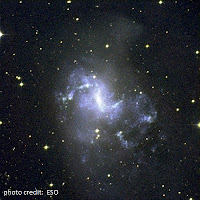


The Topsy Turvy galaxy is relatively close to our own Milky Way, being some 13 million light years from us.  As a result, an OIII filter can also be used on 1313 to bring out the H2 regions.  Unfortunately for me this night, high cloud had started forming and obscuring 1313 by the time I was ready to use an OIII filter.

The less than ideal viewing conditions had me draw on all my observing experience to patiently tease out details from 1313.  And this battle made the experience with 1313 so much more memorable!

Object:  NGC 1313, starburst barred spiral galaxy
Scope:  17.5” Karee push-pull dob
Gear:  10mm XW, 200X
Location:  Katoomba Airfield, Australia
Date:  11th January, 2016
Media:  Soft pastel on black paper


I hope you enjoy these pieces.

Alex.

Thursday, 31 December 2015

Low magnification Copernicus

There is a trap we can fall into with the Moon – we want to push magnification as far as possible all the time.  And if conditions are not up to scratch, we abandon efforts.

A recent sketch I saw on an astro forum reminded me that any telescope is better than no telescope.  So if your scope is of a small aperture, it is still an exquisite asset.

So, what do the two above statements have to do with anything?  Well, it means that you make use of what scope and conditions present.

This forth straight night of clear skies, conditions were particularly poor.  Even at 100X, the image of the Moon was showing a shimmering boil.  At another time I would just have packed up the old orange tube C8.  But the memory of that earlier sketch done using a smaller aperture had me take courage at looking at using much lower magnification than I would typically use.

This night, magnification at under 100X showed a minimal amount of boil, and this was to be the magnification to sketch the Moon with.

Even 91X, the amount of detail is staggering to behold.  The image though smaller, is much more concentrated.  This night I chose to revisit an old friend, Copernicus, and the surrounding maria and mountain ranges.  For me, mountain ranges prove the most difficult to replicate.  The detail is frightfully complex, and my eye struggles to accept just one point of detail, instead trying to absorb a dozen!  Tonight was a chance to take up a mountain range challenge too.

Copernicus was staggering.  The mountain range Montes Carpatus to the north appearing from over the terminus into the morning light with spectacular shadows.  To the south is Reinhold, with its crater floor still in complete shade.  To the east is Erastothenes, another big crater that is surrounded by a ring of secondary impacts created by ejecta material, just like Copernicus has.  Erastothenes is located off the end of the western spur of Montes Apenninus mountain range.

Further north of Copernicus, the terminator is rolling over the middle of Mare Imbrium.  The terminator here has a lovely, smooth rolling appearance.

And of course, there is the ray system radiating out from Copernicus, spread out over the surrounding maria.

I hope you enjoy this piece.

Alex.

Object:  Copernicus and surrounds
Scope:  C8, 8” SCT
Gear:  22mm LVW, 91X
Date:  20th December, 2015
Location:  Sydney, Australia

Media:  Soft pastels, charcoal and white ink on black paper.


Saturday, 26 December 2015

Maginus, and this time no clouds...

I had a fabulous run of clear skies and the chance to sketch.  Three nights in a row.

Conditions this night were the best for a very long time.  400X was showing some ‘boil’, but still very acceptable.

In scanning the terminator for a sketch subject, I came across Magnius.  I had attempted to sketch Maginus one time before – on that occasion clouds rolled in, killing off the sketch session early.

Maginus is a very ancient feature.  Its floor is flooded, with the tips of the central peaks just showing.  The peaks, and the sheer size of Maginus are the only features still keeping the semblance of the original crater.  Otherwise, it has been heavily altered by the successive impacts that are slowly obliterating the remains of Maginus.

It is these newer impacts superimposed onto the massive ancient crater that make this a very attractive sketching subject.  The floor of Maginus is surprisingly clear of particularly major impacts, with the major newer impacts doing their best to obliterate the ramparts (wall structures) of the underlying crater.  This grace of luck has left the remains of the central peaks visible, and the remainder of the floor peppered with smaller impacts.

Maginus makes for a fantastic telescopic target.  Highly tortured, and littered with hundreds of craters inside and surrounding Maginus, and the floor making for a good test of conditions to be able to spy out the mass of tiny impacts.   Curious to call these craterlets at ‘tiny’, as the ‘tiny’ craters still range from 500m to 2km in diameter!  Bloody big holes all the same!

Alex.

Object:  Crater Maginus and surrounds
Telescope:  C8, 8” SCT
Gear:  5mm Hyperion, 400X
Date:  19th December, 2015
Location:  Sydney, Australia
Media:  Soft pastels, charcoal and white ink on black paper.


Tuesday, 22 December 2015

Rima Hyginus - homage to my first telescope

 I got my first telescope when I was 13 years old.  A modest 50mm Tasco refractor.  At the time I thought it was the bee’s knees.

Though a modest little scope, I first saw Saturn with it, Halley’s Comet, and of cause, the Moon.

The little Tasco came with a map of the Moon, and I spent many hours studying it.  It also showed several rile systems, including Rima Hyginus, which I managed to see with it!  The thrill of seeing such a fine line traced on the lunar surface was one I have never forgotten.

Unlike the previous night, conditions were not as steady.  An 8mm eyepiece showed just too much ‘boil’ in the image.  My modest little 9mm TMB Type ii proved a better choice for the evening.  Might not seem like too much of a magnification difference, but it was sufficient to reduce the boil to a tolerable amount.

This night, while looking for a sketching target, I came across Rima Hyginus, and that happy memory of my first view of it came rushing back.  So, this night I sketched Rima Hyginus to commemorate my experiences with that little Tasco and what it showed me.

Rima Hyginus lies between Mare Vaporum & Sinus Medii, and carves a curious line that makes a turn about halfway through its ripping of the lunar surface, with a crater so very conveniently smack bang on the elbow of the bend, which also give the rile its name.

To the North (right of the rile) lies a dark and tortured series of lava mountains.  On other occasions when Rima Hyginus looked like a sketch candidate, this dark area looked too sinister and difficult to lay down.  No escaping this time.  I found it a lovely area to sketch!  Very detailed and intricate.

To the east of Hyginus, a second long rile system, Rima Ariadaeus.  Together the riles make for a spectacular area.

Object:  Rima Hyginus
Scope:  C8, 8” SCT
Gear:  9mm TMB Type ii, 222X
Date:  18th December, 2015
Location:  Sydney, Australia

Media:  soft pastels, charcoal and white ink on black paper.


Saturday, 19 December 2015

Posidonius et Lacus Somniorum - a volcanic paradise

Finally, a clear night, the Moon is up, and I have time for a sketch!  I’ve hit the jackpot!!

The feature I sketched tonight was one of the first features I sketched when I took up the pencil after many years, Posidonius.  I was not aware at the time that this was Posidonius – did not matter really as the features on offer were most exciting.

What was interesting for me once I found out the identity of the crater, was how much more I was able to identify and details I was able to pick out that previously made no sense to me.

Posidonius is not one of the oldest features.  In fact, it is really just middle aged.  For the oldest of features, a crater this size would have been totally flooded with lava, and only a ghost crater left – much smaller impacts than Posidonius can be seen close by which are totally flooded, making those features very, very ancient, much older than Posidonius (such as Le Monnier to the top left of Posidonius).  The youngest of features happened once the Moon’s crust was so thick that a crater this size on longer was able to punch through to the molten rock below.  Posidonius is one crater where the crust was punctured to allow for partial flooding, but the flooding was not complete, and now long extinct volcanos pot-mark its flooded floor and surrounds.

Posidonius is one extraordinary feature.  The partially flooded floor not only has many volcanic vent and domes, but it is also highly fractured, with several massive riles running through it.  Its walls are also very interesting.  Close examination shows what appears to be a second rim on the inside.  This is something I have not seen before.  There are a few co-centric craters on the Moon, but these all are on the small side.  Posidonius is some 100km in diameter – for a second concentric impact to happen of such a close size to the parent impact is just too much of a long shot.  The highly fractured crater floor may hold a clue to this apparent secondary crater – massive upheaval from subterranean magma forces pushing up.  Mind you, this is only speculation on my part.  There are other examples of magma lifted features on the Moon, which is why I suspect this may be the reason for the double rim.

Posidonius’ floor is not the only location of volcanism in this area.  Lacus Somniorum appears featureless, but is actually littered with domes all around Posidonius.  One clue to spotting the shield volcanoes is to look for totally isolated ‘mountains’ with no other mountain range within cooee of it, only an empty lava field.  This would make the chances of this solitary ‘mountain’ to actually be a shield volcano or Dome.

Alex.

Object:  Posidonius et Lacus Somniorum
Scope:  C8, 8” SCT
Gear:  8mm LVW, 250X
Date:  17th Dec. 2015
Location:  Sydney, Australia

Media:  Soft pastels, charcoal and white in on black paper.


Sunday, 6 December 2015

More Sun and more learning...

Hello everyone,

The opportunity arose for a session with the Sun this Sunday morning.  Today a sector of the Sun contained several prominence features and some sunspot and filament activity.

The prominences on show were particularly fast moving.  Their shape and patterns changed markedly over the half hour of sketching them.  Such were the changes that I just could not go back to the first lot I laid down as the structures were pretty much totally altered.  This surprized me, and lesson learned about not leaving proms to come back to them – you just don’t know how fast these features are changing.

Conditions were not great today.  Thermal haze was constantly having the image come in and out of focus.  The chromosphere features are particularly sensitive to thermal haze, and it took some stubborn persistence to get the detail I wanted.  A nice cluster of sunspots and a lot of plages around them made for a great challenge to lay down.  Oh, if that haze would just stop!!!

When close to finishing this piece, it occurred to me to stop down the aperture of the scope, essentially out of curiosity just to see what would happen.  I got a lovely surprise that this helped to increase the contrast and made features easier to see with the magnification taken really low down.  Second lesson learned today.

My kids came out for a look when I completed my sketch.  I quietly mention to be patient with the red & black image as our eyes are not accustomed to seeing in such colours, and that the details will reveal themselves as if by magic.  And they always come up with great questions that test my knowledge and ability to answer their questions in terms that make sense to them, and not overwhelm them with science jargon.  I have an outreach night coming up in April with the Girl Guides’ – my kids’ questions make for some good practice!

Alex.

Object:  Sun – (left to right) broken detached pyramid, mound & anomalous prominences, sunspots, plages & filaments
Scope:  ED80 f/7.5
Gear:  Daystar Quark, 25mm Pl, 101X
Date:  6th December, 2015, 10:30 am AEST
Location:  Sydney, Australia.

Media:  Coloured soft pastels & charcoal on A5 size black paper.